
VIP member

Box type pipeline stacked variable frequency water supply equipment
Release time: August 5, 2013 4:17:53 Box type pipe network stacked variable frequency water supply equipment is an integrated water supply equipment t
Product details
1 Overview of Box type Pipe Network Stacked Variable Frequency Water Supply Equipment
The box type pipeline stacked variable frequency water supply equipment mainly consists of a sealed structure water tank, a boosting device, a stabilizer, and a pump set. The system is divided into two inlet streams, one into the water tank and the other into the stabilizer. When the water consumption is low and the tap water service pressure is high, the equipment directly draws water from the tap water network and supplies water by stacking. When the tap water service is low, the boosting device starts to work, pressurizing the water in the water tank to the set service pressure and compensating for the difference, thereby achieving the goal of energy saving, no secondary pollution, and constant pressure water supply. It has no impact on the municipal water supply network and is a new generation of energy-saving products in the water supply field.
2 Scope of application for non negative pressure variable frequency water supply equipment
Residential water use: such as high-rise buildings, residential water areas, villas, etc.
Public places: such as hospitals, schools, sports centers, golf courses, airports, etc.
Commercial buildings: such as hotels, office buildings, department stores, large saunas, etc.
Irrigation: such as parks, playgrounds, orchards, farms, etc.
Other: such as the renovation of water pools and other forms of water supply.
Public places: such as hospitals, schools, sports centers, golf courses, airports, etc.
Commercial buildings: such as hotels, office buildings, department stores, large saunas, etc.
Irrigation: such as parks, playgrounds, orchards, farms, etc.
Other: such as the renovation of water pools and other forms of water supply.
3 Frequency conversion range of box type pipeline stacked variable frequency water supply equipment

Adjust the speed of the water pump to maintain a constant pressure in the pipeline network. When the pressure detected at the outlet pipeline of the system is lower than the starting pressure value of the water pump, the speed of the water pump can be automatically adjusted to keep the outlet pressure constant. When the water pump reaches the power frequency speed but the pressure cannot reach the set pressure, the system will start the P2 and P3 water pumps in sequence; As the water consumption decreases, the outlet pressure increases and the speed of the water pump gradually decreases. If the speed of the water pump drops to the set speed of the system, the system will stop the water pump operation according to P3, P2, P1.
4 Functional characteristics of box type pipeline stacked variable frequency water supply equipment
1. To maintain a constant outlet pressure, the equipment detects the outlet pressure in real-time through a pressure sensor, compares the detected value with the set value, and determines the number of motors and pumps to be put into operation and the output frequency of the frequency converter (reflected as the motor and pump speed), in order to achieve the goal of constant pressure water supply.
2. When there is a power outage and the water supply line is cut off, the system uses 747D and bypass channels to achieve uninterrupted water supply during the power outage. In other words, the system automatically switches to municipal tap water pressure supply during the power outage.
3. The highly automated system can achieve fully automatic control, with functions such as first building/automatic switching, timed rotation of main and auxiliary pumps, pressure adjustment, constant pressure, high and low point pressure protection, under phase protection, leakage protection, overload protection, overheating protection, water shortage protection, no water parking, instant trip protection, etc. Additionally, the human-machine interface can be configured according to user needs, allowing for visual remote adjustment, monitoring, and maintenance.
4. The sanitary overcurrent components are made of food grade materials that comply with international water safety standards.
5. Saving investment saves land area, reduces building load capacity, and thus greatly reduces investment costs.
6. The cost saving system ensures constant pressure in pipelines by adjusting the number of units and operating speed according to changes in water consumption. When the water consumption is high, the input power is large, and when the water consumption is low, the input power is small. When the water consumption is low (such as at night), the system is supplied with a low-power pump with variable frequency speed regulation and constant pressure water supply. The system has been running at a high efficiency point, greatly reducing operating costs and saving over 60% of energy.
2. When there is a power outage and the water supply line is cut off, the system uses 747D and bypass channels to achieve uninterrupted water supply during the power outage. In other words, the system automatically switches to municipal tap water pressure supply during the power outage.
3. The highly automated system can achieve fully automatic control, with functions such as first building/automatic switching, timed rotation of main and auxiliary pumps, pressure adjustment, constant pressure, high and low point pressure protection, under phase protection, leakage protection, overload protection, overheating protection, water shortage protection, no water parking, instant trip protection, etc. Additionally, the human-machine interface can be configured according to user needs, allowing for visual remote adjustment, monitoring, and maintenance.
4. The sanitary overcurrent components are made of food grade materials that comply with international water safety standards.
5. Saving investment saves land area, reduces building load capacity, and thus greatly reduces investment costs.
6. The cost saving system ensures constant pressure in pipelines by adjusting the number of units and operating speed according to changes in water consumption. When the water consumption is high, the input power is large, and when the water consumption is low, the input power is small. When the water consumption is low (such as at night), the system is supplied with a low-power pump with variable frequency speed regulation and constant pressure water supply. The system has been running at a high efficiency point, greatly reducing operating costs and saving over 60% of energy.
5 Functional characteristics of box type pipeline stacked variable frequency water supply equipment
1. To maintain a constant outlet pressure, the equipment detects the outlet pressure in real-time through a pressure sensor, compares the detected value with the set value, and determines the number of motors and pumps to be put into operation and the output frequency of the frequency converter (reflected as the motor and pump speed), in order to achieve the goal of constant pressure water supply.
2. When there is a power outage and the water supply line is cut off, the system uses 747D and bypass channels to achieve uninterrupted water supply during the power outage. In other words, the system automatically switches to municipal tap water pressure supply during the power outage.
3. The highly automated system can achieve fully automatic control, with functions such as first building/automatic switching, timed rotation of main and auxiliary pumps, pressure adjustment, constant pressure, high and low point pressure protection, under phase protection, leakage protection, overload protection, overheating protection, water shortage protection, no water parking, instant trip protection, etc. Additionally, the human-machine interface can be configured according to user needs, allowing for visual remote adjustment, monitoring, and maintenance.
4. The sanitary overcurrent components are made of food grade materials that comply with international water safety standards.
5. Saving investment saves land area, reduces building load capacity, and thus greatly reduces investment costs.
6. The cost saving system ensures constant pressure in pipelines by adjusting the number of units and operating speed according to changes in water consumption. When the water consumption is high, the input power is large, and when the water consumption is low, the input power is small. When the water consumption is low (such as at night), the system is supplied with a low-power pump with variable frequency speed regulation and constant pressure water supply. The system has been running at a high efficiency point, greatly reducing operating costs and saving over 60% of energy.
2. When there is a power outage and the water supply line is cut off, the system uses 747D and bypass channels to achieve uninterrupted water supply during the power outage. In other words, the system automatically switches to municipal tap water pressure supply during the power outage.
3. The highly automated system can achieve fully automatic control, with functions such as first building/automatic switching, timed rotation of main and auxiliary pumps, pressure adjustment, constant pressure, high and low point pressure protection, under phase protection, leakage protection, overload protection, overheating protection, water shortage protection, no water parking, instant trip protection, etc. Additionally, the human-machine interface can be configured according to user needs, allowing for visual remote adjustment, monitoring, and maintenance.
4. The sanitary overcurrent components are made of food grade materials that comply with international water safety standards.
5. Saving investment saves land area, reduces building load capacity, and thus greatly reduces investment costs.
6. The cost saving system ensures constant pressure in pipelines by adjusting the number of units and operating speed according to changes in water consumption. When the water consumption is high, the input power is large, and when the water consumption is low, the input power is small. When the water consumption is low (such as at night), the system is supplied with a low-power pump with variable frequency speed regulation and constant pressure water supply. The system has been running at a high efficiency point, greatly reducing operating costs and saving over 60% of energy.
Variable frequency drive controls the movement mode
One frequency converter can achieve the effect of multiple frequency converters and save electricity and soft start water pumps
The starting current of the subsidy pump is 200-300% of the rated current.
|
Increased water usage |
Pump 1 |
Pump 2 |
Water pump 3 |
The water usage is decreasing |
Pump 1 |
Pump 2 |
Water pump 3 |
|
0 |
Frequency conversion operation |
|
|
100% |
Power frequency operation ← |
Power frequency operation ← |
|
|
33% |
Power frequency operation → |
Frequency conversion operation |
|
66% |
Power frequency operation ← |
Frequency conversion operation |
|
|
66% |
Power frequency operation → |
Power frequency operation → |
Frequency conversion operation |
33% |
Frequency conversion operation |
|
|
Fixed method of frequency converter control
The frequency converter is fixed on a pump for operation, and excessive starting current and pressure fluctuations may occur when the auxiliary pump is started. The starting current of the subsidy pump is 500-600% of the rated current.
|
Increased water usage |
Pump 1 |
Pump 2 |
Water pump 3 |
The water usage is decreasing |
Pump 1 |
Pump 2 |
Water pump 3 |
|
0 |
Frequency conversion operation |
|
|
100% |
Frequency conversion operation |
Power frequency operation ← |
Power frequency operation ← |
|
33% |
Frequency conversion operation |
→ Power frequency operation |
|
66% |
Frequency conversion operation |
Power frequency operation ← |
|
|
66% |
Frequency conversion operation |
→ Power frequency operation |
→ Power frequency operation |
33% |
Frequency conversion operation |
|
|
The difference between variable frequency drive control movement mode and alternating operation mode
Alternating operation is the basic function of constant pressure variable frequency water supply. When all water pumps are stopped and restarted, the initially started pump operates with variable frequency speed regulation, and it is the main pump. Start the main pump alternately every time or at any set time to prevent a pump from starting frequently.
|
Alternate operation |
Pump 1 |
Pump 2 |
Water pump 3 |
|
At initial startup |
(1) Variable frequency operation |
(2) Power frequency operation |
(3) Power frequency operation |
|
When restarting |
(3) Power frequency operation |
(1) Variable frequency operation |
(2) Power frequency operation |
|
When restarting |
(2) Power frequency operation |
(3) Power frequency operation |
(1) Variable frequency operation |
Operating curve diagram of variable frequency water supply system

By using an intelligent controller to maintain constant pressure under extreme flow changes, it can be seen that the variable frequency water supply system has superior performance in providing suitable water supply conditions.
Types of Control Methods for Variable Frequency Constant Pressure Water Supply Equipment
1、 生活水池自灌式供水方式

2. Self suction water supply method for domestic water tanks.
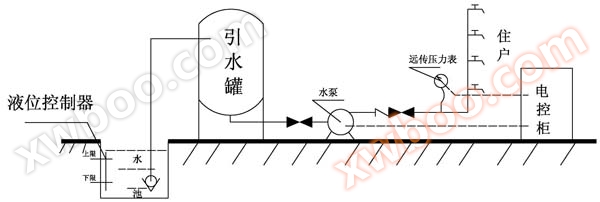
This water supply method is called self-priming, where the water level of the pool is lower than the inlet of the water pump. The water pump's suction is unreliable and prone to water loss and diversion. The solution is to install a water intake tank, as shown in the picture, and add a water intake tank in front of the pump.
3. Variable frequency water supply method for water wells.

Online inquiry
-
Contacts
-
Company
-
Telephone
-
Email
-
WeChat
-
Verification Code
-
Message Content
-